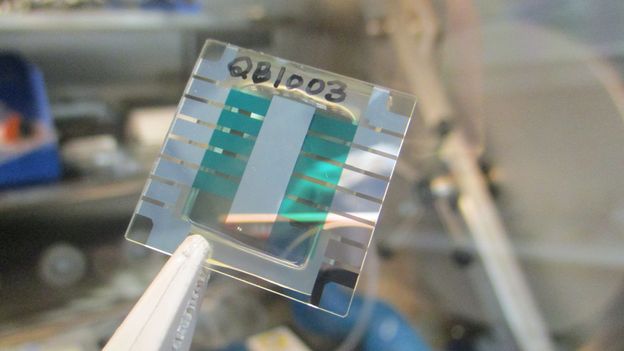
A laboratory in Australia has produced the world's first working quantum battery prototype, a device that behaves in ways that overturn conventional understanding of how batteries function. The prototype demonstrates a property so unusual that scientists themselves describe it as deeply counterintuitive: charging speed increases proportionally with the battery's physical size.
Traditional batteries follow a predictable relationship between capacity and charging time. Larger batteries typically require more time to charge fully. Quantum batteries, however, operate under entirely different rules rooted in quantum mechanics principles like entanglement and superposition.
How Quantum Batteries Work Differently
The fundamental distinction lies in the physics governing these devices. While classical batteries rely on conventional electrochemical reactions, quantum batteries leverage quantum mechanical effects to store and deliver energy. When quantum systems become sufficiently large and interconnected, the charging rate accelerates dramatically rather than slowing down.
This scaling advantage emerges from quantum entanglement, where particles become correlated in ways that have no classical equivalent. Researchers working on the prototype found that as they expanded the battery system to include more quantum components, the collective charging capability grew exponentially rather than linearly.
The implications extend beyond laboratory curiosity. Quantum computers, which themselves operate on quantum principles, could potentially be powered by matching quantum batteries. The energy delivery characteristics of quantum systems align naturally with the operational requirements of quantum processors.
From Laboratory to Real-World Applications
Moving beyond proof-of-concept presents significant engineering challenges. The prototype must remain in highly controlled conditions, typically requiring extremely low temperatures and isolation from environmental interference. Translating laboratory success into commercially viable products demands advances in materials science, thermal management, and quantum error correction.

The potential applications span multiple sectors. Quantum computing facilities could reduce their infrastructure demands significantly if quantum batteries prove practical at scale. Mobile devices and consumer electronics represent a longer-term possibility, though technical hurdles remain substantial.
Research teams continue refining the prototype and exploring whether the scaling advantages observed in controlled settings will persist in more realistic operational environments. Early results suggest that quantum batteries could fundamentally reshape energy storage technology—if engineering challenges can be overcome.