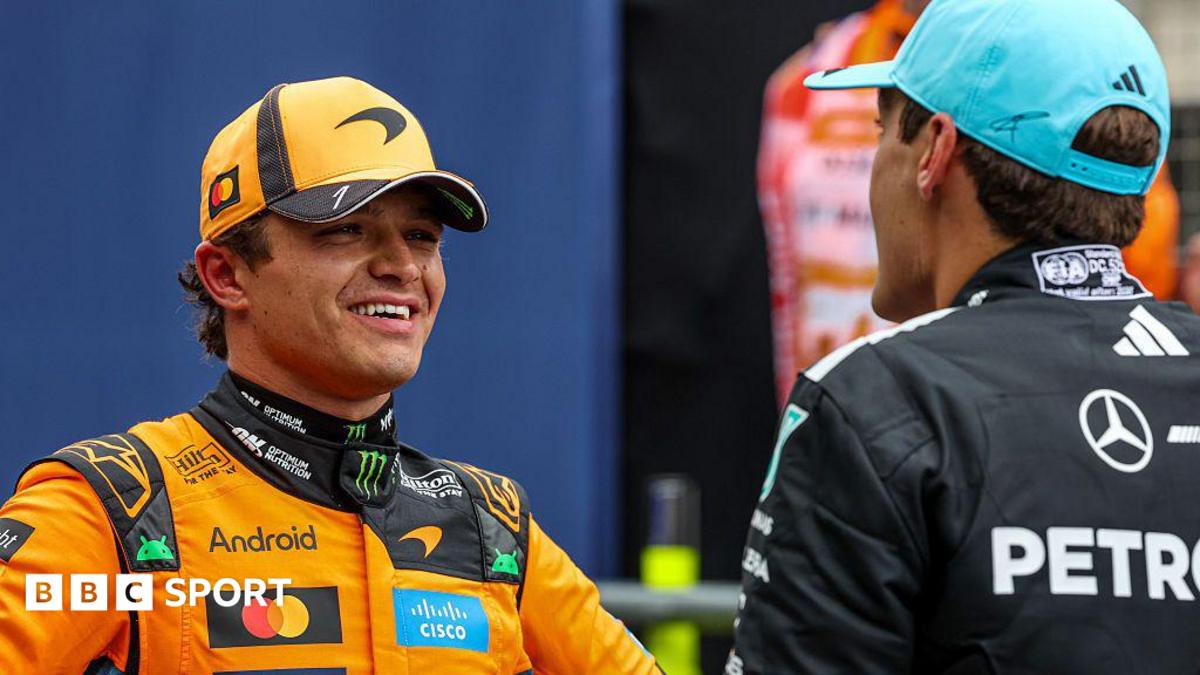
Lando Norris enters the Dutch Grand Prix from pole position for the second consecutive event, yet the McLaren driver is tempering expectations for victory at Zandvoort on Sunday. His caution stems from a sobering lesson delivered earlier in the day when Mercedes' George Russell dominated the sprint race despite starting second on the grand prix grid.
Norris secured pole by 0.28 seconds over Russell, exploiting McLaren's advantage through the middle sector's high-speed corners, particularly the downhill Turn Seven known as Scheivlak. However, he qualified fourth and seventh-quickest in the first and final sectors, which feature more technical, low-speed corners where competitors proved stronger.
Why qualifying pace doesn't guarantee race success
The disconnect between qualifying performance and race competitiveness reveals a fundamental challenge in modern Formula 1. During a single qualifying lap with fresh tires and minimal fuel, Norris's McLaren demonstrated clear superiority in specific corner types. But the sprint race exposed a different picture: Russell's Mercedes exhibited superior overall pace over a distance, while Ferrari's Charles Leclerc improved significantly as the race progressed, ultimately overtaking Norris.
Norris acknowledges this dynamic explicitly. "The sprint race disappointed me quite a bit because of our pace," he stated, noting that his qualifying lap required extreme commitment—characterized by aggressive braking, high-speed sliding, and constant car adjustments rather than a smooth, controlled performance.
The tire management trade-off
During races, F1 drivers must manage tire temperatures carefully in high-speed corners to prevent overheating and degradation. This necessity fundamentally changes how drivers approach turns where qualifying allows flat-out attack. Norris cannot replicate his qualifying strategy over 72 laps without risking severe tire wear, placing his initial advantage in jeopardy.
The reigning world champion's cautious outlook reflects realistic assessment rather than false modesty. Mercedes and Ferrari both demonstrated competitive race packages during Saturday's sprint, suggesting Sunday's 307-kilometer race will prove considerably more challenging than his pole position suggests. Norris will spend Saturday evening analyzing data from the sprint, seeking improvements that carry through to the grand prix.
The Dutch Grand Prix represents the final race at Zandvoort before the circuit departs the F1 calendar. Norris leads from pole, but Russell's Mercedes and Leclerc's Ferrari have positioned themselves as genuine threats to victory in a race that promises considerably more drama than the qualifying session suggested.