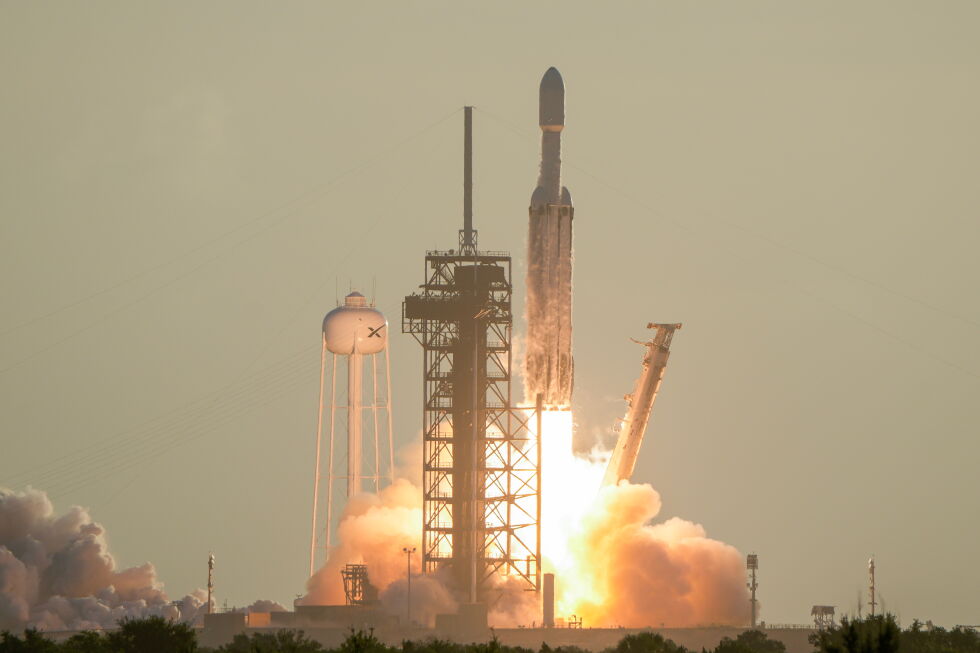
NASA achieved a major milestone in space exploration on Sunday when SpaceX successfully launched the $4 billion Nancy Grace Roman Space Telescope from Kennedy Space Center in Florida. The ambitious observatory will travel to a stable gravitational point 1 million miles from Earth to join the already-operational James Webb Space Telescope in humanity's quest to map the universe.

Key takeaways
- Roman will reach its observation post at the L2 Lagrange point in approximately three months
- The telescope aims to discover and characterize exoplanets orbiting distant stars
- It honors Nancy Grace Roman, NASA's first chief astronomer, for her pioneering contributions
- Roman's wide field of view will enable unprecedented cosmic surveys and dark energy research
- SpaceX delivered the spacecraft on schedule from Florida's Kennedy Space Center
The Roman Space Telescope represents a generational leap in astronomical capability. Once operational at the L2 point—a gravitational balance zone between Earth and Sun—it will survey cosmic phenomena with a field of view significantly broader than existing space observatories. This expanded perspective will enable researchers to detect previously hidden worlds around other stars and gather data on dark energy's role in the universe's expansion.
The three-month transit to L2 marks the beginning of what mission planners expect to be a transformative era in space science. Roman's sensors and instruments have been engineered to detect distant planets and map galactic structures across billions of years of cosmic history. The telescope's namesake, Nancy Grace Roman, spent decades advocating for space-based astronomy before her death, fundamentally shaping NASA's approach to observing the cosmos beyond Earth's atmosphere.

With Roman now en route, NASA's space telescope infrastructure will encompass multiple complementary observatories working in concert. The pairing of Roman with Webb and ground-based instruments creates an unprecedented framework for understanding planetary systems, stellar evolution, and the fundamental forces shaping our universe.