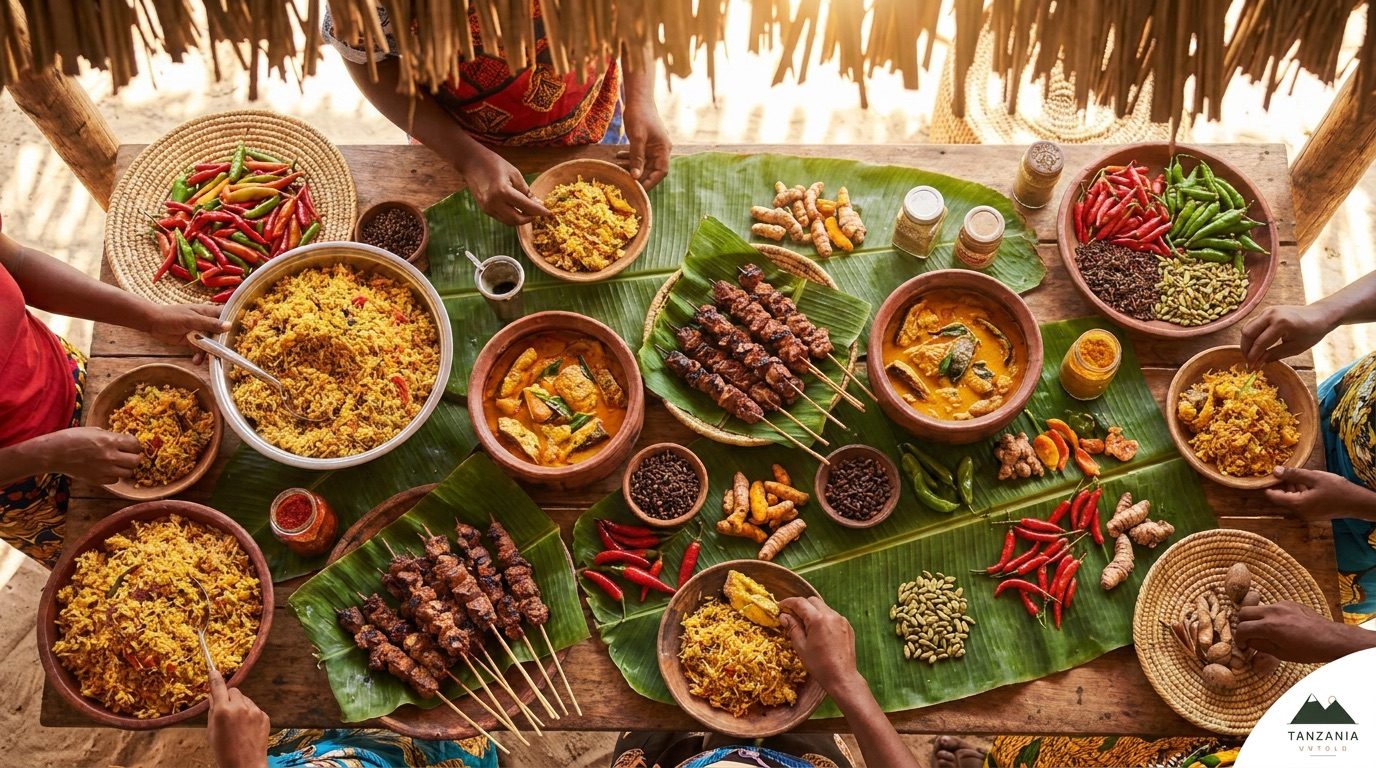
Most Tanzania itineraries are built around what you'll see: lions on the plains, snow on Kilimanjaro, turquoise water off Zanzibar. Almost nobody plans a trip around what they'll eat, which is a genuine oversight. Tanzanian food rarely gets the international spotlight that Ethiopian or Moroccan cuisine enjoys, but it tells the same story every great cuisine tells — of trade routes, migration, coastline, and the produce that thrives in a particular soil. For travelers willing to eat like a local instead of sticking to the lodge buffet, Tanzania's food is one of the most underrated parts of the trip.
Ugali and the Mainland Table
At the center of most mainland meals sits ugali, a stiff, dense maize porridge cooked until it holds its shape, then torn by hand and used to scoop up whatever stew accompanies it. It's less a dish than a utensil, humble on its own but essential to how food is eaten across the country. Alongside it, nyama choma — grilled meat, usually goat or beef, cooked slowly over charcoal and served with almost no seasoning beyond salt — is closer to a social ritual than a menu item. Weekend afternoons at a nyama choma spot, meat arriving in batches as it finishes grilling, are as much about the gathering as the food.
Mchicha, a stewed greens dish similar to spinach, and pilau, a spiced rice dish loaded with cardamom, cumin, and cinnamon, round out the everyday table. Pilau in particular reveals Tanzania's coastal trading history in a single bite — the spice blend is almost identical to versions found across the Indian Ocean trade network, from Oman to Gujarat.
The Swahili Coast Flavor Shift
Travel from the interior toward Dar es Salaam or Zanzibar and the food changes noticeably, leaning into coconut, seafood, and the spice trade that made Zanzibar famous. Coconut-based fish curries, octopus grilled with garlic and lime, and biryani laced with saffron and clove reflect centuries of Omani, Persian, and South Asian influence layered onto East African staples. Zanzibar pizza, despite the name, is a street-food invention unrelated to Italy — a thin dough stuffed with minced meat or vegetables and egg, folded, and fried on a flat griddle until crisp.
Street food culture along the coast is worth building time for specifically. Forodhani Gardens in Stone Town turns into a nightly grill-and-market scene, and smaller towns up and down the coast run their own quieter versions, usually centered on whatever the day's catch brought in.
Chai, Coffee, and the Art of Slowing Down
Tanzania grows some genuinely excellent coffee, particularly from the slopes around Kilimanjaro and the Southern Highlands, though for decades most of the best beans were exported rather than consumed locally. That's shifted somewhat as specialty cafes have opened in Arusha and Dar es Salaam, giving travelers a chance to drink Tanzanian coffee where it's grown rather than after it's crossed an ocean. Chai, meanwhile, spiced with ginger, cardamom, or cinnamon and brewed strong with milk, remains the more everyday ritual — the drink offered when you arrive somewhere, a small gesture of hospitality that shows up constantly on the road.
Eating Like You Mean It
The easiest way to miss Tanzanian food entirely is to stay inside hotel restaurants built around a generic international menu. The better version of the trip involves local markets, roadside grills, and small family-run places where the menu might be one dish done well rather than twenty done adequately. Guides and drivers, more often than not, know exactly where to go if you simply ask where they'd eat on their own time.
Food this tied to geography and history rewards curiosity. A plate of pilau on the coast or ugali and nyama choma inland isn't just a meal between safari drives — it's as legitimate a way of understanding Tanzania as any game drive or mountain trek, and one far too many visitors skip entirely.
Next time you're planning a Tanzania trip, build in at least one meal that isn't at the lodge. Ask your guide where they'd eat, and go there instead.